
For twenty years, the unit of SEO was the page.
You picked a keyword, built a page around it, earned some links, and waited for Google to rank the whole thing.
That unit is breaking apart.
AI Overviews, ChatGPT, Perplexity, and Google's own AI-powered results don't “read” your page and rank it as a block. They chunk it: they break it into paragraphs, list items, and sentences, then pull the single best-matching chunk to answer a specific question. Your page might rank #1 and still lose the click, because the answer already got lifted out and shown above it. Some call this zero-click search, where earning the citation and the brand mention is now how you create awareness and send visitors to your site.
Search used to reward the best page. Generative answers reward the best paragraph, no matter where it lives on that page.
This isn't a reason to panic or rewrite your site. It's a reason to change how you write inside the pages you already have.
What chunking looks like
When an AI system builds an overview, it's not skimming your homepage top to bottom. It's breaking your content into retrievable pieces, usually somewhere between a sentence and a paragraph, then scoring each piece on its own for how well it answers a specific query.
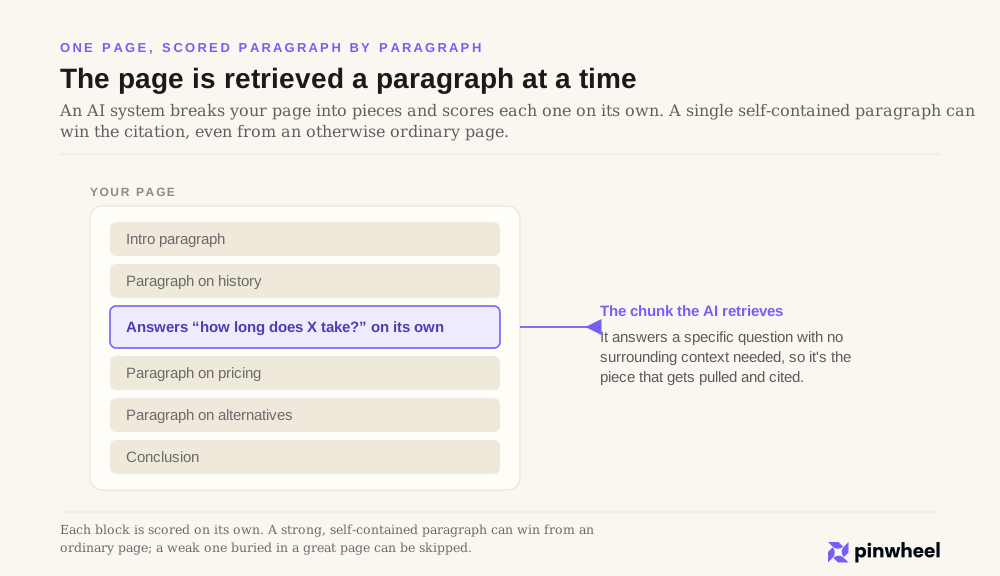
Each block is scored independently. A weak paragraph buried in an otherwise excellent page can get skipped entirely, while a strong, self-contained paragraph on a mediocre page can win the citation.
The paragraph, not the page, is now the atomic unit of retrieval.
Writing paragraphs that survive being pulled out of context
A chunk-friendly paragraph has to work as a standalone answer, because that's exactly how it will be used. The content gets taken out of your page and shown next to four other sources, with no surrounding context.
As we mentioned earlier, this approach has some real benefits, though as with anything, there are tradeoffs worth considering depending on your specific situation and goals.
Switching to a subscription pricing model typically increases customer lifetime value by 20 to 40%, but it slows initial revenue growth for the first two to three quarters.
Read your paragraph completely on its own, with no sentence before or after it. If it still makes sense, answers a real question, and states a specific fact or claim, it can survive standing alone in an AI Overview. If it needs “as mentioned above” or a “this” with no clear referent, it can't.
A good chunk-friendly paragraph usually:
- Opens with the answer, not a windup
- Names specific numbers, entities, or steps instead of vague generalities
- Runs 40 to 80 words, long enough to be substantive, short enough to be lifted cleanly
- Doesn't lean on a pronoun (this, it, that) to carry its main subject
Don't stop writing for human beings
Here's the trap. Once people learn that paragraphs get chunked and scored, they start writing paragraphs for the algorithm: keyword-stuffed, robotic text that reads like it was generated by a checklist. That's a bad move, for two reasons.
- It doesn't actually improve your odds of being retrieved. Retrieval scores a paragraph on how closely its meaning matches the question, not on keyword density, so engineering text for extraction gains you nothing there and just makes it worse to read.
- Even when it gets pulled, a human still has to trust it. Your name or brand next to that paragraph is doing real work, and the reader who clicks through has to land on a page that reads like it was written by someone who knows something. Authorship and E-E-A-T still matter.
Every paragraph you write now has two readers: the retrieval system deciding whether to lift it, and the human deciding whether to trust it. Write the second one first. Clear, specific, human writing is already what chunking systems reward. You don't need a separate “robot voice.”
The good news is these two goals mostly point the same direction. Direct, specific, well-organized writing is what both humans and retrieval systems prefer. The instinct to “write for the algorithm” usually just means writing worse: more literal, more repetitive, less alive. Resist it.
Before you touch a page that already ranks, stop
This is the part people get wrong the most. They read about chunking and go rewrite every paragraph on every page, including ones that are already ranking well in traditional search.
Don't do that.
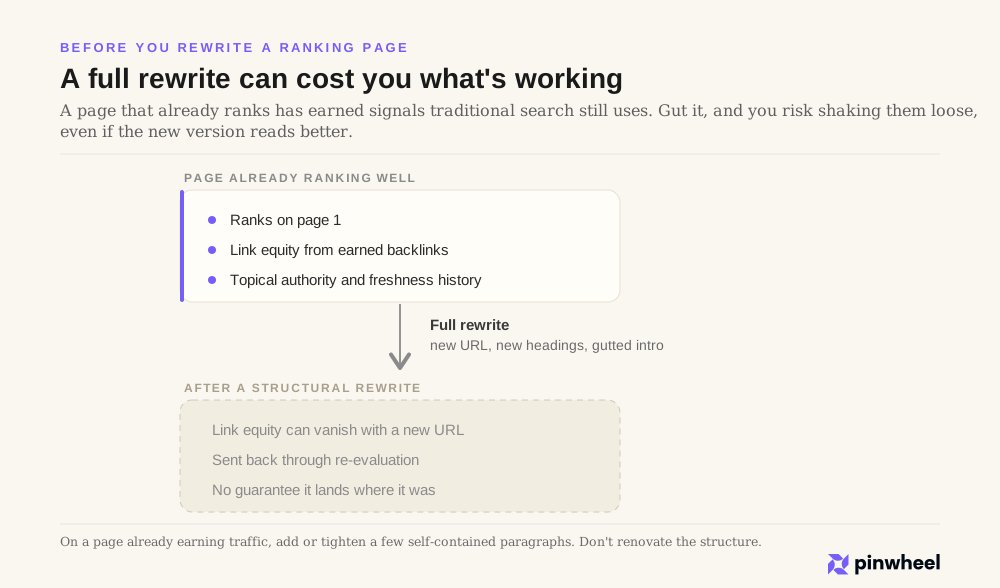
A page that ranks well has accumulated signals traditional search still relies on: link equity from earned backlinks, topical authority, and years of freshness history. A structural rewrite (new headings, reorganized sections, a different URL, a gutted intro) can shake those loose even when the new version is objectively better written. Change the URL and the link equity can vanish; reorganize enough and the page goes back through re-evaluation with no guarantee it lands where it was.
If a page is already earning traditional search traffic, treat AI-chunking optimization as an addition, not a renovation. Add or tighten a few self-contained paragraphs where a clear question-and-answer opportunity exists. Leave the structure, headings, and URL alone.
The safer move on high-performing pages is surgical:
- Tighten one or two paragraphs that answer a specific, common question, without restructuring the page around them
- Add a short, direct answer near the top of an existing section rather than rewriting the section
- Leave headings, URLs, and internal linking exactly as they are
- Save full rewrites for pages that are already underperforming, where you have nothing to lose
Save the bigger structural experiments, new formats, aggressive re-chunking, FAQ blocks added onto everything, for pages that aren't ranking yet. Those pages have nothing to protect and may even perform better with the changes.
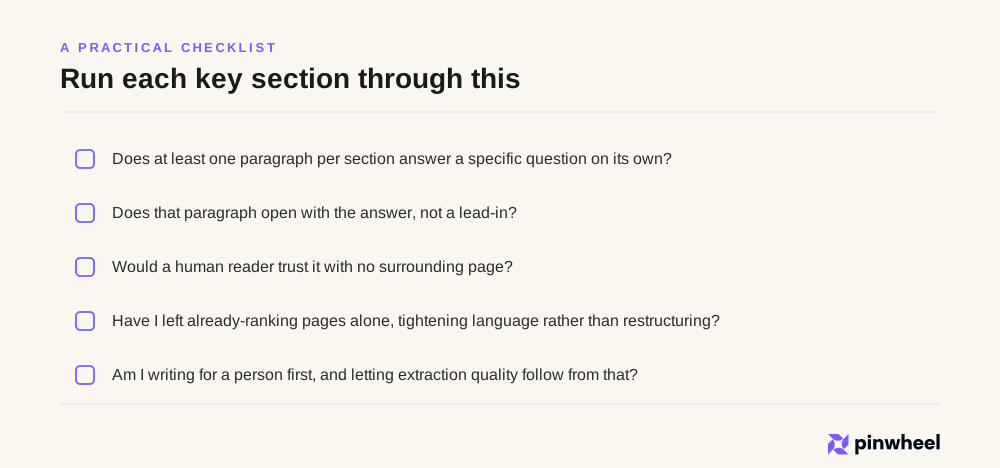
A practical checklist
Before you publish, run each key section through this.
In the end
Pages still matter, for search and for AI. They're what earns the click, builds the relationship, and holds the reader once they arrive. But the unit of competition has moved down a level. Every paragraph on your site is now working on its own, in front of a system deciding whether it's worth showing to someone who never scrolls down to see the rest.
Write paragraphs that can stand alone. Write pages that are still worth visiting. And if a page is already doing well, don't touch the parts that are working. Just make sure a few of its paragraphs are ready to be pulled out and put to work.