
It's never been more important to have the most updated content on your website.
Not only do the LLMs want the freshest content, but they will literally pull old dates, old information, and the like, and state them as fact when they answer the questions your prospective customers are asking. And they'll do it with confidence.
This just happened to me when I was trying to figure out college move-in day. AI Overview gave me the wrong date, right year. Why? It found last year's date on the website and took it upon itself to change the year to this one.
Luckily, I checked with the school and was able to confirm the right date. But this illustrates my point perfectly.
Old search meant that if you asked Google a question, it would surface the most likely pages to have your answer. Now, the AI Overview and other LLMs create the answer.
The old way would have seen me visiting the school site, seeing the date was last year, and realizing they didn't have this year's move-in date set yet. With the new search process, I would have thought I had my answer. The joke would have been on me when I brought my kid to school a day later than everyone else.
This shows why having an updated site, and enough offsite signals carrying the story and information you need to share about your product, business, or brand, is so important.
When you want to show up in the LLMs, you'll want the right information to be there. That's why we start with a Content Evaluation to find the areas that are outdated or inaccurate, and then build a plan of attack to correct them.
Why your existing content may not work well for LLMs
AI search isn't just about keyword research anymore.
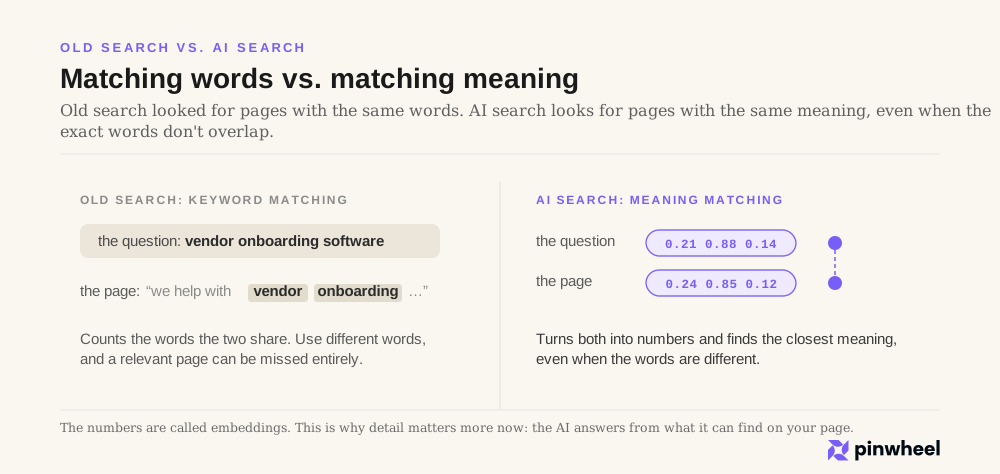
To understand this, it helps to know what changed under the hood. Old-school search was mostly keyword matching. The engine looked for pages that literally contained the words you typed, ranked them, and handed you a list to click through. You did the reading.
AI search reads for meaning instead of just matching words. It turns both your question and the content on a page into long strings of numbers, called embeddings, and finds the content whose meaning sits closest to your question, even when the exact words don't line up. (You'll hear this called semantic or vector search. They're really the same idea: the vectors are what let the system judge meaning.) Then, instead of pointing you to a page, it uses what it found to write the answer. That's why detail matters so much more now. The AI is doing the answering, so the answer has to actually be on your page.
Supporting evidence
LLMs need supporting evidence to understand your business and answer questions about it. Done well, that evidence gets the model to:
- Cite you
- Actually send traffic to you
- Stay consistent across platforms
Just like in SEO, that means both on-page and off-page signals:
- Content on your own site
- Citations on reputable third-party sites relevant to your niche
- A clean, technically sound site
If your website leaves important questions unanswered, the AI may use another source instead. That's where you run into trouble.
How to prioritize content updates
First, you need to prioritize. Sites with hundreds of pages can't have everything updated at once. We recommend starting with your Most Valuable Content (MVC).
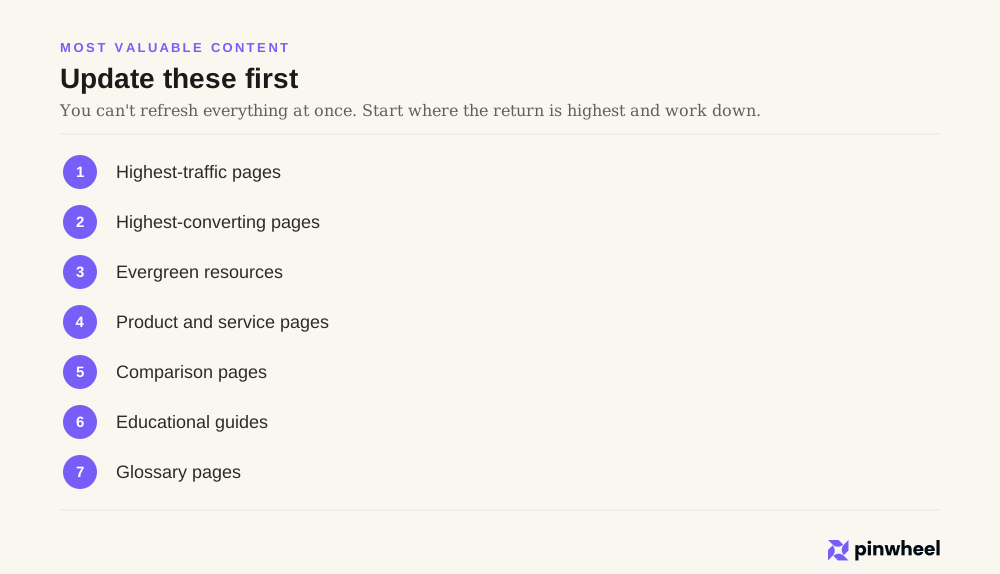
Updating your most valuable content gives you a better return than publishing dozens of new articles.
Once you have your master list, here's how we work through it.
1. Remove thin or duplicate content
A cleaner site makes it easier for search engines and AI systems to understand your expertise.
We analyze the content on your site based on the areas you want to grow and the customers you want to reach. Each piece of content gets a score and a direction: update, remove, or leave alone. Then we execute on the plan.
2. Update outdated information
This should be a no-brainer, but sometimes the scale of the work is so overwhelming that it slips through the cracks. In one case, we managed a suite of 12 sites where new data came out every May. Updating everything used to take an employee two weeks, with a lot of room for user error.
Now we use a tool to help us do a few things on some of our sites:
- Retain the existing content, including internal and external links
- Update outdated statistics (we don't like anything older than a certain year; for example, nothing before 2020, which can already feel dated)
- Find and replace old pricing with like-for-like content
- Update and sunset product features. The LLMs use fan-out queries to gather information about your products, so old features and descriptions need to go
LLMs like updated content. Search engines liked it too, but it matters even more for LLMs.
3. Add to and reorder content
Your old page style may not work well in today's landscape. To find an answer, AI systems don't read your whole page at once. They split it into smaller pieces (often called chunks) and pull the piece that best matches the question. So each section of your page needs to make sense on its own, out of context. Here are a few ways to write for that.
Answer first
Keep concise answers near the top for LLM visibility. This is also good for your reader, but it runs counter to how content used to be written, where the answer got buried under setup so people would stick around longer. For LLMs, put the answer up top.
FAQs
To FAQ or not to FAQ? It's a bit of an overdone tactic, but still useful in the right spots, so use it when it helps and use it sparingly. AI writing tools practically come with this built in, so we're starting to see FAQs everywhere, even where there's no real need for one.
Question headings
Or headings in general. This is a great way to break up your content for both LLMs and search engines. People tend to ask LLMs full questions as prompts, then dig in with deeper questions. If you put those questions as headings, you lead people straight to the answer on your page.
Be direct
Don't shy away from the questions consumers are actually asking about your product or business. You can't control the questions they ask, but you can shape the response. If you already have comparison pages (you vs. a competitor), make sure they answer the questions really being asked, not just the ones that paint you in the best light.
Adding these sections and modifying existing pages makes it easier to earn visibility in the LLMs.
4. E-E-A-T it up
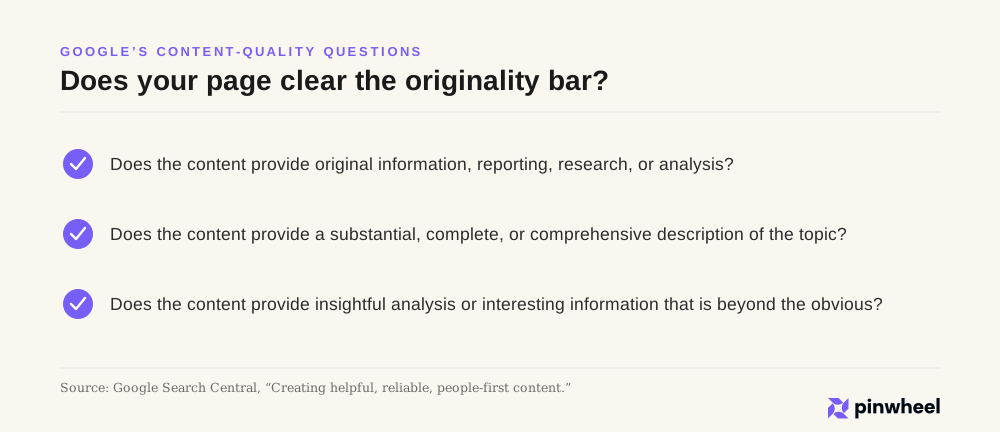
Much like traditional search, LLMs want to surface expert content, so putting your author bio and credentials right at the top helps. Infuse your content with original research, case studies, and real-life examples.
Here are a few of Google's recommendations on adding originality to show expertise.
What if I can't use real stories?
(See how we did a question heading there?)
Some niches make this harder. We work a lot in online healthcare, where HIPAA puts real limits on using patient information. You can technically discuss a properly de-identified case, but doing it right is a legal minefield (removing a name isn't enough), so we usually steer clients away from patient stories entirely and lean on other kinds of originality instead.
Other niches are different. Home services, software, education, and others don't carry the same restrictions. LLMs love original data, so build it in wherever you can so your brand stands out.
5. Improve your content structure
Structure (or the lack of it) is one of the highest-leverage things you can fix to earn quick wins in LLM search. Same as with SEO, everything from the URL to the words on the page should be clear to the reader.
This overlaps with step 3, but it's worth checking all of your top pages to make sure they aren't too wordy. A few ways to tighten them up:
- Instead of paragraphs, break information into bulleted or numbered lists
- Use tables (ideally no more than three or four columns) to distill things like comparisons
- Use short paragraphs and short sentences. A hallmark of AI writing is long, winding sentence structure. Humans don't write that way and don't read that way, so when you human-edit, break the sentences up
- Use a clear topic sentence. This is back to answer-first content: tell the reader what the page is about from the beginning
Does the content match the query?
(There we went with a question heading again.)
There are hundreds of prompts that are pathways to your site. Queries, fan-out queries, follow-ups, people use LLMs to answer a question and then keep the conversation going.
It's impossible to know every single thing someone types into an LLM about your business. So how do you make sure you're covered? Focus on topical completeness. If you have a SaaS product, for example, make sure you cover:
- Related concepts
- Synonyms
- Common questions
- Comparisons
- Examples
- Use cases
Cover every possible thing you think a customer may ask (about your brand and also competitors and you in relation to your competitors), and you give the LLM the information it needs to surface your page in the answers instead of someone else's.
Final thoughts
AI search makes the need to update your site content more important than ever. The sites most likely to get the citation are the ones that have clear, accurate, and well-structured information that is easy for the LLMs to access. Refresh your content regularly, answer real customer questions, and make your pages easier to understand through the way you structure the content, and you improve your chances of being shown in both traditional results (SEO) and AI answers (AEO/GEO).
Content refresh work isn't a one-and-done thing. LLMs pull from your site and the rest of the web continuously, so keeping these pages up-to-date is more important than ever. In the old "plain SEO" days, this might mean that old pages decayed or just were not shown anymore in search results. Now, with LLMs using information from your entire site, you have to try harder than ever to make sure the content is not outdated, or else your customers may think it's the truth.
Outdated pages appear as current factual information the moment an AI system decides to cite them.
A regular content audit catches this before it costs you a customer or a bit of trust in your brand.
Start with your Most Valuable Content. Remove what's thin or duplicated. Update what's outdated. Restructure what's hard to scan. Build in the expertise signals that show LLMs and readers alike that you know what you're talking about.
Do this consistently, and your site becomes a source AI systems can rely on, not one they have to guess about or work around.